|
SafetyVet "Solutions for the Veterinary Professions" |
 Call us at (423) 336-1925 |
Is is enough to have all staff members print and sign their name on a document acknowledging that training was completed?
OSHA
requires a “performance oriented” approach to required safety
training. That means it is not enough to just present the
information; it must be presented in manner and language suitable
for the employee to understand.
Depending on the reason for an OSHA inquiry into your
training plans, it may not be enough to just have a sign-in sheet
for a meeting or seminar as proof of training. For example, if
the reason they are looking is just to ascertain if you have records
or if you have completed a recurring required training, a sign-in
sheet may be enough at that moment. However, if the reason
they are looking is the result of a suspected workplace injury or a
complaint that training was inadequate, they are likely to want more
information on the content of the training AND what steps the
employer took to ensure it was understood.
At a minimum, in addition to the “sign in sheet,” it’s also
important to maintain a written record of the content of the
training/meeting to prove what was said or taught in the training.
Just keep this in mind: mere attendance as a meeting where a piece
of information or training was discussed rarely ensure comprehension
of the materials; lots of folks are at meetings and just days later
can’t explain a single point that was discussed at that meeting.
That’s why we strongly suggest adopting some method to
evaluate the staff member’s understanding of the training.
In the past, OSHA has accepted performance demonstrations
and written tests as evidence the staff member understood the
training. Performance evaluations are where the instructor or
suitably knowledgeable person “watches, then signs off” that the
staff member performed a required task properly. This type of
validation is common for topics such as the donning, use, and
removal of PPE (like respirators) and for operating dangerous
machinery. In the veterinary hospital, that often means
operation of the radiology machine, anesthesia machine, and similar
medical devices. There must be a written objective checklist
that the evaluator uses for this method to be acceptable.
The written test method is more widely used and suitable
for many topics, including HAZCOM, fire prevention and response,
etc. We think it is essential for every training episode to
include a short written “quiz” that every staff member must complete
to be considered “trained” on that topic. The staff member
must score 100% on such a quiz (in other words, they can’t just
understand “some” of the safety rules.) If a staff member
misses a question (or questions) on such a quiz, it is acceptable to
coach them on the correct procedure, then allow THE STAFF MEMBER to
change their answer on the test along with signing the change.
The instructor will then annotate on the quiz that the staff member
was retrained on the correct procedure after the first answer and
was allowed to change their answer because he/she demonstrated the
correct solution to the instructor after further coaching.
As for issuing a certificate: I like them and I use them in
my sessions. I think the staff member looks at the training a
little more seriously when the “earn a certificate” and OSHA
compliance officers seem to like them, BUT they have limitations.
Like the sign-in sheets, they will often suffice as evidence that a
person attended a specific meeting. A completion certificate will
only help prove understanding if there was an examination of the
staff member’s competence AND written evidence to back it up.
Click here for more info and ideas on
delivering safety training in a veterinary hospital.
Did You Know...?
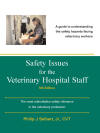
Our Safety Issues for the Veterinary Hospital Staff workbooks are the most comprehensive and easy to use veterinary specific safety training tools available.